




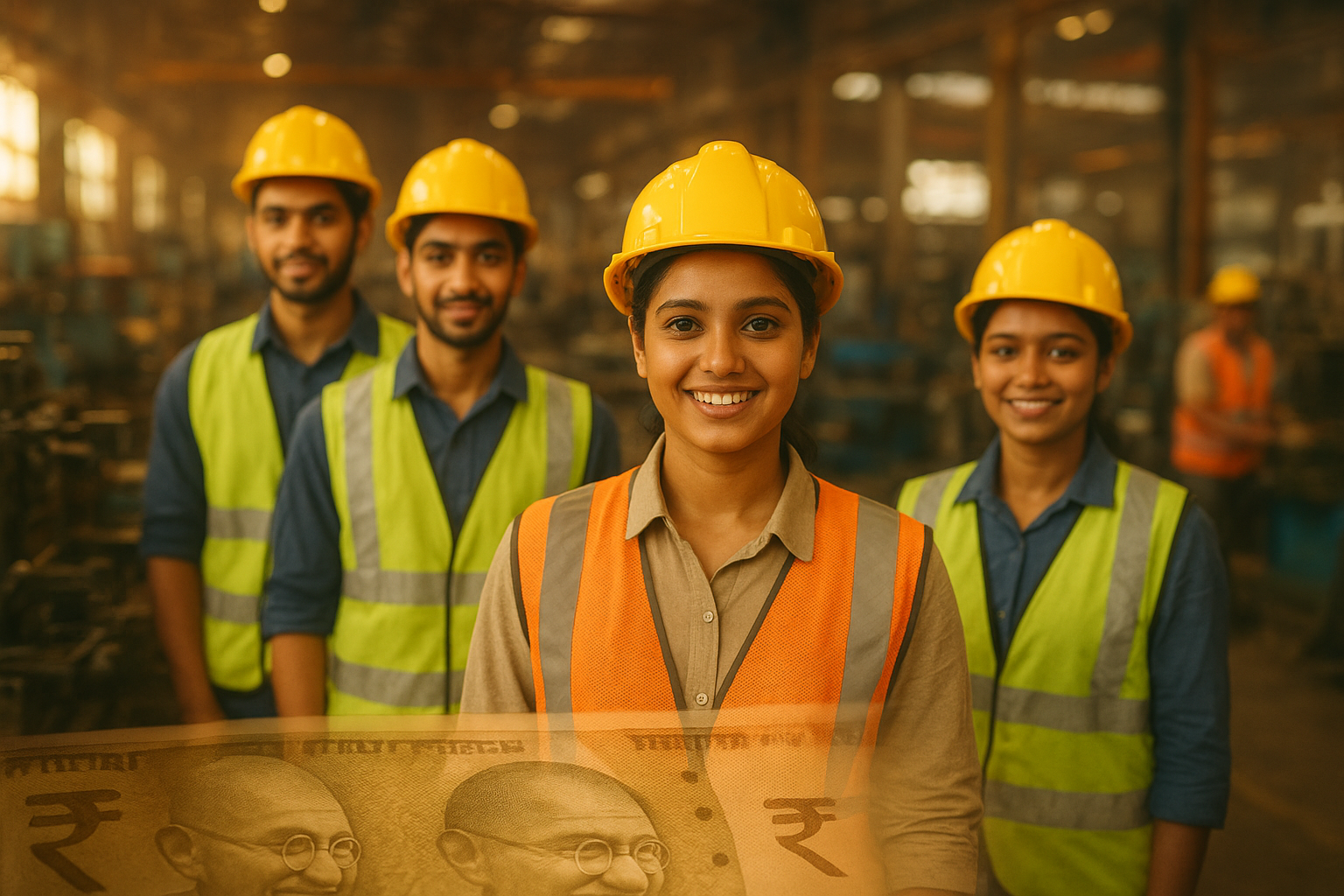
As India steps into a new financial year, the economic landscape is filled with both optimism and caution. Growth projections remain strong compared to global peers, yet rising inflation, global supply chain instability, geopolitical tensions, and tightening international financial conditions pose real risks to India’s growth momentum. In such a scenario, one question takes center stage:
Can the Indian government, through the Union Budget 2026, protect jobs even if economic growth slows down?
This year’s budget reflects a clear intention: to stimulate job creation not only through direct employment schemes but also by strengthening the long-term foundations of India’s labor market. Through incentives, social security expansion, skilling initiatives, MSME support, and manufacturing-focused reforms, the Budget attempts to create a strong safety net that can cushion employment even during economic stress.
Below is a comprehensive analysis of how Budget 2026 aims to protect livelihoods during a potential slowdown, and whether these measures will be enough to safeguard India’s workforce.
1. Why Job Protection Matters During a Slowdown
When economic activity slows, businesses often respond by:
- Cutting costs
- Freezing hiring
- Reducing contract or temporary workers
- Slowing down investments
For a country with a large youth population and a growing workforce, these disruptions can create long-lasting structural challenges. Rising inflation can further reduce purchasing power, leading to a cycle where lower demand causes additional job losses.
This is exactly why the government’s focus on job protection is both necessary and urgent.
The central idea behind Budget 2026 is simple, If growth slows, employment should not collapse.
To achieve this, the budget uses a mix of targeted incentives, structural reforms, sectoral support, and long-term workforce development.
2. Employment-Linked Incentives: Encouraging Companies to Hire Even in Tough Times
One of the most important features of recent budgets, continued in 2026, is the emphasis on Employment-Linked Incentive (ELI) schemes. These schemes encourage companies to hire more workers by reducing the initial cost burden associated with onboarding new employees.
a. Scheme A: Incentives for First-Time Workers
This scheme targets youth entering the formal workforce for the first time.
Key features include:
- Direct financial incentive to first-time workers
- Support during the first month of employment
- Target age group: 18–25 years
- Income threshold to ensure inclusion of low and middle-income youth
The objective is twofold:
- Bring more young workers into the formal job market
- Prevent a slowdown in hiring for entry-level roles
b. Scheme B: Boosting Jobs in Manufacturing
Manufacturing is one of the largest employment-generating sectors.
Under this scheme:
- Both the employee and employer receive support through EPFO-based benefits
- Incentives last through the first four years of employment
- Youth working in labor-intensive manufacturing units receive priority
This is designed to protect manufacturing jobs even during periods of low demand.
c. Scheme C: Reducing Hiring Costs for Employers
Here, the government reimburses up to ₹3,000 per month of the employer’s EPF contribution for two years.
Why this matters:
- Hiring becomes more affordable
- Employers avoid layoffs during economic stress
- Formal jobs increase with social security protection
Together, these schemes create an environment where companies are encouraged, even financially rewarded, for hiring workers during uncertain economic cycles.
3. Skilling, Upskilling & Reskilling: Building a Workforce Ready for Tomorrow
If the job market is disrupted during a slowdown, workers with outdated skills are the first to face unemployment. To protect their livelihoods, the government has expanded its skilling and training initiatives.
a. Upgrading 1,000 ITIs Across India
A major investment has been made to modernize Industrial Training Institutes, including:
- Industry-linked courses
- Smart classrooms
- Updated machinery
- Partnerships with advanced manufacturing firms
This ensures graduates are employment-ready.
b. Digital and Green Skill Development
Budget 2026 reflects a shift toward future-oriented skilling:
- Green technology training
- AI and data analytics modules
- Drone operation courses
- Micro-entrepreneurship support
These skills prepare youth for emerging sectors less affected by cyclical slowdowns.
c. Women-Centric Skilling Programs
To boost female labor force participation, the budget includes:
- Women-only skilling batches
- Work-from-home readiness training
- Support for women entrepreneurs in digital sectors
- Hostels and creches near industrial clusters
These initiatives help women remain in the workforce even during downturns.
4. Strengthening Manufacturing: Creating Jobs at Scale
Manufacturing is one of the few sectors that can absorb India’s large workforce. Budget 2026 continues the government’s multi-year push for domestic production.
a. Support to Labor-Intensive Industries
Sectors like:
- Leather and footwear
- Apparel and textiles
- Furniture
- Toys
- Electronics assembly
receive targeted incentives, subsidies, and export support.
These industries employ millions of workers and can quickly scale production when conditions improve.
b. MSME Growth & Expansion
MSMEs account for nearly one-third of India’s GDP and are a major source of employment. Budget 2026 strengthens MSME hiring capacity through:
- Higher turnover thresholds
- Credit guarantee expansion
- Simplification of tax and compliance
- Digital platforms for easier market access
When MSMEs stay afloat, local employment remains stable.
c. Production-Linked Incentives (PLI)
Continued focus on electronics, solar equipment, semiconductors, and pharmaceuticals ensures long-term job creation through large-scale manufacturing.
5. Social Security & Worker Protection: A Safety Net for the Vulnerable
A critical part of job protection is ensuring that workers who lose jobs or struggle with reduced income are not pushed into poverty.
Expanded EPFO Coverage
More workers across gig, platform, and informal sectors are now being brought under social security schemes.
Benefits include:
- Pension and retirement savings
- Accident insurance
- Medical benefits
- Minimum social protection for informal employees
Support for Gig Workers
Digital workers, delivery staff, ride-hailing drivers, freelance service providers, receive:
- Accident insurance
- Skill certificates
- Access to credit
- Inclusion in digital welfare platforms
This marks a major shift in India’s employment landscape.
6. How These Policies Protect Jobs Even If Growth Slows
The Budget uses a layered strategy to protect employment:
1. Reduce hiring costs
Employers receive financial relief, allowing them to continue hiring despite lower demand.
2. Improve worker skills
Skilled workers are less likely to lose jobs and more likely to find new ones.
3. Support MSMEs
When small businesses thrive, employment remains stable in local economies.
4. Boost labor-intensive sectors
These industries can maintain hiring even in slow-growth scenarios.
5. Expand social protection
Workers remain financially secure, reducing economic stress.
6. Focus on long-term resilience
Digital and green skilling ensures the workforce remains relevant in a rapidly changing world.
7. Will These Measures Be Enough? A Realistic Outlook
While the budget offers strong support, the effectiveness depends on three factors:
a. Implementation
Schemes must be executed smoothly across states and industries.
b. Private Sector Response
Companies must actively participate in employment-linked incentives.
c. Demand Conditions
If global recessionary pressures worsen, even the best incentives may have limited short-term impact.
However, India’s combination of:
- a young workforce
- expanding manufacturing base
- rising services sector
- strong digital economy
- proactive government initiatives
means it is better positioned than many countries to protect jobs during a slowdown.
Conclusion
The Union Budget 2026 does not merely focus on short-term employment fixes. Instead, it strengthens India’s labor market through sustainable, long-term strategies.
By combining employment incentives, skilling infrastructure, manufacturing expansion, MSME support, and social protection, the budget creates a robust framework that can help protect jobs even if economic growth slows.
Budget 2026 does not just create jobs, it creates the conditions for job security, workforce resilience, and long-term economic stability.
I hope you find the above content helpful. For more such informative content, please visit HR Global Hub.